The church’s social teaching is a rich treasure of wisdom about building a just society and living lives of holiness amidst the challenges of modern society. Its roots are in the Hebrew prophets who announced God’s special love for the poor and called God’s people to a covenant of love and justice. It is a teaching founded on the life and words of Jesus Christ, who came “to bring glad tidings to the poor . . . liberty to captives . . . recovery of sight to the blind”(Lk 4:18-19), and who identified himself with “the least of these,” the hungry and the stranger (cf. Mt 25:45). (taken from: The Roman Catholic Diocese of Grand Rapids)
The Mass
The Mass, or celebration of the Eucharist, is the principal liturgical action in the Catholic Church. It is the central action and aspect of our lives of faith and the primary way we worship God as a community. The word “Mass” comes from the Latin word, miss a meaning “mission” or “sending” because the liturgy is meant to send forth the faithful to deliver the Good News of Jesus and to be his sacramental presence in the world. Jesus Christ revealed the Mass at the Last Supper. It was the last action He took to prepare the Twelve Apostles before his death. First Corinthians, which contains the earliest account of the Eucharist, reveals what the Last Supper meant for the Church’s future: Jesus foresaw a long time during which his presence would be invisible to his followers. With his words “Do this in memory of me” he intended that the events of the Last Supper would be repeated again and again so that through this re-enactment Jesus would be intimately present to his people for generations to come. (taken from: The Roman Catholic Diocese of Grand Rapids)
The Bible
The Church accepts and venerates the Bible as inspired. The Bible is composed of the 46 books of the Old Testament and the 27 books of the New Testament. Together they makeup the Scriptures. It is through the Scriptures that we meet and come to know Jesus. Sacred Scripture is a part of all sacramental celebrations and is used to awaken a response of faith in the listeners. When the word is proclaimed, Christ himself is speaking. Resources:
From the USCCB: About the New American Bible, Revised Edition | Daily Mass Readings ( Listen| Read) | Understanding the Bible
The Liturgical Calendar
The Liturgical Year is marked by the special seasons of Advent, Christmas, Lent, the Triduum (or Three Days), Easter, and Ordinary Time. The Liturgical Year begins on the first Sunday of Advent, which usually occurs around the beginning of December or the end of November, and ends on the feast of Christ the King. The Liturgical Year Calendar tells us what readings the Church has designated to be used for each day. It also names the special feasts and commemorations celebrated during each season and marks the dates of remembrance of the saints. The Liturgical Year Calendar does not mark the passage of time, but helps us celebrate and understand more completely the entire mystery of Jesus Christ, from his incarnation and birth to his ascension, the day of Pentecost, and the expectation of his return in glory.
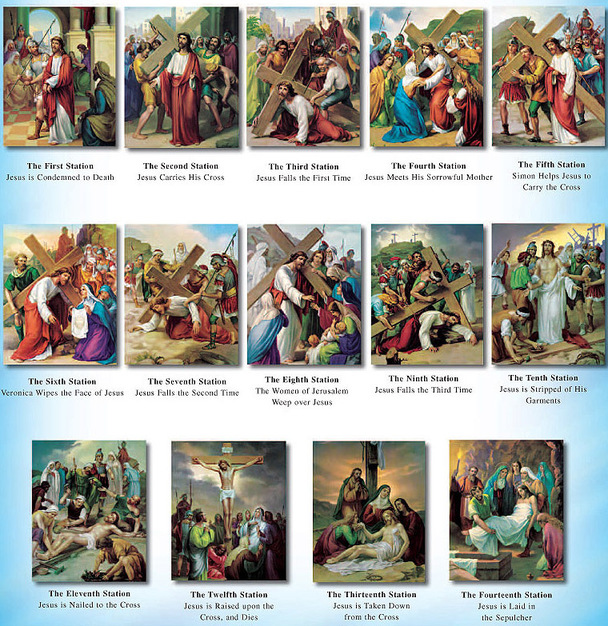
Interactive Stations of the Cross
An interactive experience for the whole family! Brought to you by Busted Halo on YouTube!
Experience Stations of the Cross anytime. The Video Meditations include music, photos, meditation suggestions and commentary to bring the Passion to life in our current culture.